Why Version Control Exists: The Pendrive Problem
Why Version Control Exists?
How Did Developers Manage Code Before Version Control?
Imagine this scenario. You’re building a project. You write code on your laptop. Then you copy it to a pen drive. Then you give that pendrive to your teammate. Your teammate makes changes. Then gives it back to you.
Sounds simple? Not really.
The “Final_Final_v2_Updated_Latest” Problem:
Before version control systems, developers used:
Pendrives
Emails
Shared folders
ZIP files
File names like:
project_final.zip
project_final_v2.zip
project_latest_final_real.zip
project_final_FINAL.zip
And here’s what used to happen:
Someone overwrites someone else's code
Changes get lost
Nobody knows who edited what
No history of changes
No easy way to go back to an older version
Without version control:
Dev A edits line 10
Dev B edits line 10 differently
Dev C edits something else
Now what? Who wins? Who overwrote whose work? No one knows. There’s no tracking. No merge system. No timeline. No accountability. This becomes worse as teams grow. 😐
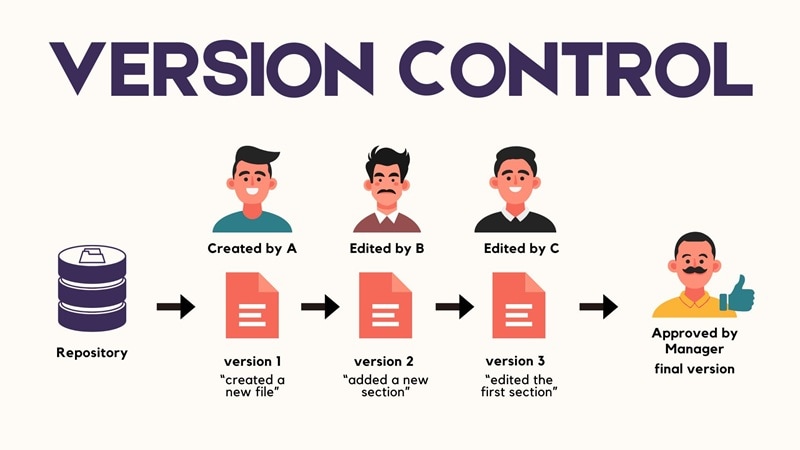
As projects grew larger and teams became distributed, this manual way of managing code simply stopped working. That’s when Version Control Systems were introduced. Instead of passing files around, developers started tracking changes. Instead of renaming files, they started creating commits. Instead of overwriting code, they started merging changes.
Version Control is a system that records changes to files over time so that you can recall specific versions later. You can:
See edit history
Go back to older versions
Work with multiple people safely
Track who did what
The Pendrive Analogy in Software Development
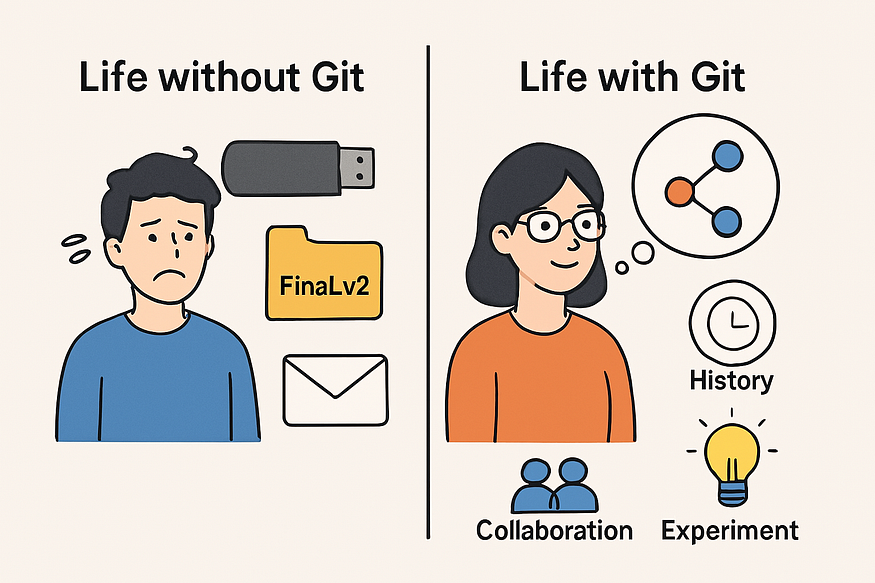
Earlier, we saw how developers used pendrives, emails, and renamed folders to manage projects.
Why does the pendrive method actually fail? Because a pendrive only stores the latest copy of a file.
It does not understand:
What changed inside the file
Who made the change
When the change happened
Why the change was made
It simply replaces one version with another.
With version control:
Each update becomes a commit
A commit records:
What changed
Who changed it
When it changed
A commit message explaining why
Instead of “project_final_v2.zip.” You get a structured history.
Version control didn’t just replace pendrives. It replaced chaos with structure. It turned file sharing into collaboration. It turned guessing into tracking. It turned overwriting into merging.
Without version control, modern software development , especially team-based development, would simply not work.
And that’s why tools like Git became essential.


